The Proportionate Oversight in Decentralized Clinical Trials (DCTs) project builds on the MRCT Center and Medable’s prior IRB/EC Considerations for DCT Review. As data capture and trial activities increasingly occur outside traditional trial sites, the characteristics of decentralized trial conduct have created uncertainty about Investigator oversight and how it should be structured when the PI has no supervisory or contractual role with others collecting data and conducting trial activities.
To help close that gap, the MRCT Center and Medable developed four new resources for investigator oversight in clinical trials with decentralized elements (DCTs), with input from the Investigator Oversight in DCT task force. These resources include a proportional oversight framework, an approach to optimize DCT elements, a model instruction sheet for local healthcare providers, and a set of illustrative scenarios covering roles and responsibilities in common clinical situations from withdrawal requests to serious adverse events.
On Thursday, September 24, 2026, from 12:00 PM – 1:00 PM ET, the MRCT Center and Medable hosted a webinar to release the resources and walk through their intended use and how they fit together. You can now watch the recording of the webinar on-demand!
This webinar will examine the use of digital twins and synthetic data in evidence generation, focusing on (1) their emerging applications across the clinical trial lifecycle, including study design, control arm reduction, and single-arm trials, and (2) regulatory expectations and experience. Panelists will discuss how evidence quality, validation approaches, performance benchmarks, and model interpretability shape decision-making, and reflect on how practical and regulatory considerations influence the adoption of these approaches in clinical research. The discussion will draw on use cases, including synthetic controls and power enhancement strategies, and will include a moderated discussion and time for audience Q&A.
Panelists:
Daniele Bertolini, Principal Scientist, Unlearn.AI
Tala Fakhouri, Vice President: Consulting, AI & Digital Policy, Real-World Research, Parexel
Topic: Digital Doppelgängers: Ethics of Digital Twins and Synthetic Data
Abstract: Clinical trial design, conduct, and analysis are benefiting from the increased use of AI, rendering it essential to address the ethical considerations that arise when new (or newer) modalities are introduced. In the last few years, AI-enabled synthetic data, retaining the characteristics of original individual-level datasets but containing no actual personal health information, has been used to conduct preliminary hypothesis generation and testing, to model eligibility criteria, and to overcome privacy concerns, particularly in rare disease research. Digital twins are AI-generated models of individual patients that simulate disease progression and treatment response, updated dynamically with real or inferred data from the physical (actual) twin. They have been used for predictive modeling and to modify trial design, the number of enrollees, and/or power calculations, increasing efficiency. They can be used prospectively (e.g., augmenting control arms) or for decision support. In both synthetic data and digital twin settings, key ethical questions arise, but each operates at a different level of abstraction.
Synthetic data are artificially generated datasets created to mimic the characteristics and distributions of patient populations statistically, but they do not correspond to identifiable individuals. Synthetic data can be used, for example, to train generative AI, minimizing privacy concerns early in AI development, and/or for trial simulation. Synthetic data, however, do not support inference at the individual level. The utility of synthetic data depends on the dataset from which it was generated; assessing bias in the source dataset is important but challenging in practice. In ultrarare diseases, for example, sufficient and representative data may not even be available. As a dataset becomes more limited and fails to capture the diversity of the patient population (as in rare and ultrarare diseases), the less generalizable its derivatives and outputs. Does the use of synthetic data reproduce and embed bias and perpetuate health inequalities? How certain are we that synthetic data are – and remain – anonymous?
In contrast, digital twins are constructed from individual participant data, are “personalized,” and acquire, ingest, and use real-time data to refine and update their attributes over time. Do participants have an implicit right to or expectation of consent to the use of their data for the construction of “their” digital twin? Does the creation of a digital twin increase the risk of reidentification and downstream privacy harms? What are the responsibilities for protecting the digital twin data, and the range of permissible future uses of digital twin data? For example, developing a digital twin may yield diagnostic, therapeutic, or other useful information about a person’s future health. Should that be disclosed or communicated? What degree of certainty is necessary for that disclosure to be warranted or permissible? Do the considerations or processes of ethics review bodies need to evolve for the review of protocols involving digital twins or synthetic data, or should additional protections be considered, as a condition of approval?
In clinical research, there is an expectation that the data that inform a trial’s results will be available for independent reanalysis and validation of the results, and to facilitate discovery. The future use of synthetic data and digital twin data, however, is complicated. At a minimum, the synthetic data represents a stable dataset that can benefit from a persistent data object identifier. But does the metadata always reflect that the dataset is derived, and should the original training dataset be available for query, reintroducing privacy risks? Digital twin data, however, is consistently updated based on the acquisition of dynamic, real-world data. How will that be reflected in the trial data? Should the original informed consent include permission for its potential secondary use, particularly as more mature digital twin data becomes increasingly identifiable?
This meeting is open to sponsors of the MRCT Center Bioethics Collaborative and select invited guests. For more information about the Bioethics Collaborative and how to become a sponsor, click here.
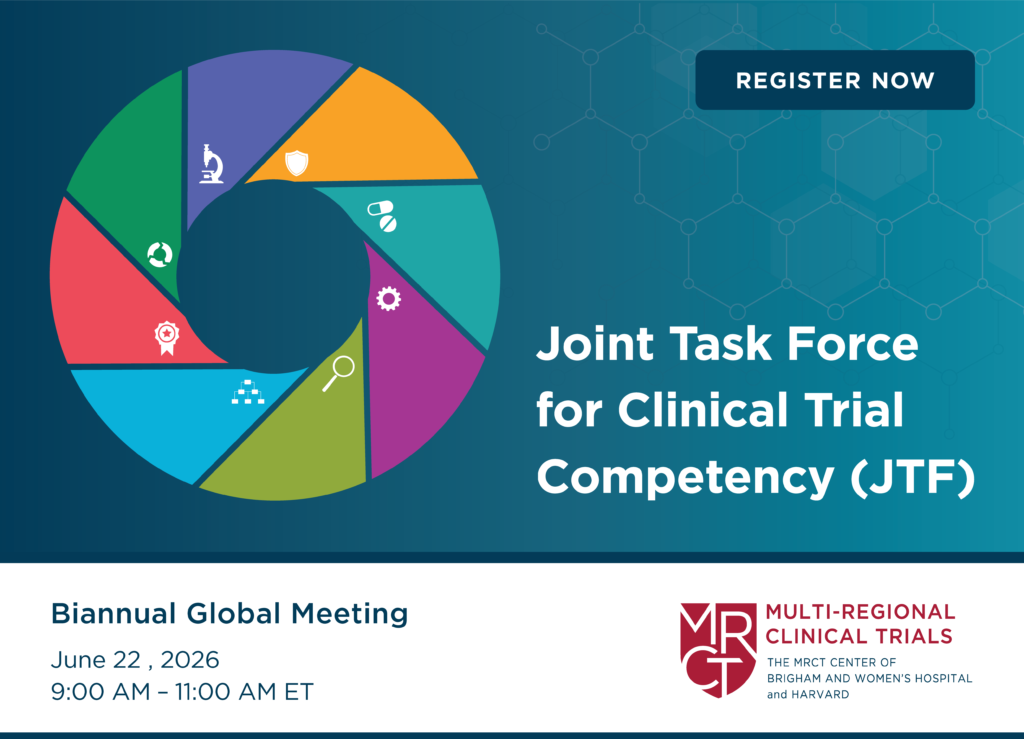
The Joint Task Force for Clinical Trial Competency (JTF), anchored at the MRCT Center, develops and disseminates standards and practices for the global clinical research workforce. By fostering a cohesive and collaborative approach, the JTF ensures that professionals have the competencies to conduct clinical trials ethically and effectively.
Our international team of investigators, educators, and clinical research professionals has developed and/or utilizes a framework that defines the knowledge, skills, and attitudes necessary for conducting safe, ethical, and high-quality clinical research.
Join us on June 22, 2026, 9:00-11:00 AM ET for the Joint Task Force for Clinical Trial Competency (JTF) Biannual Global Meeting. This meeting will focus on two recent proposed revisions to the JTF Framework: the JTF-Patient Partner Project and an update to Domain 6. We will hear about the proposed updates, discuss them with users of the JTF Framework, and gather input on any further updates needed.
Topic: What’s Mine Is Mine and What’s Yours Is Mine: Data Ownership and Sovereignty
Abstract: As big data and AI become more widespread, concerns about data privacy and security have intensified, with many countries restricting access to their citizens’ data (and, in some settings, to data stored in those countries, regardless of citizenship). International ethical guidelines, such as the Declaration of Taipei, state that individuals are entitled to control the use of their personal data. But most people fail to appreciate how much of their data is already publicly available, how much of their data they can no longer control, and how extensive their digital footprint is. When they do learn, individuals feel excluded from decisions about their information and express the desire to determine how their data is accessed and used. Are data ownership, consent, and permissions to control one’s existing data still realistic? Are there other ways to demonstrate respect when obtaining consent is not possible? Are there data governance models that can provide oversight for participant concerns or wishes? What actions, beyond consent, should be taken to respect or benefit the participants who contributed their data?
This meeting is open to sponsors of the MRCT Center Bioethics Collaborative and select invited guests. For more information about the Bioethics Collaborative and how to become a sponsor, click here.
Topic: Research Interrupted: Clinical Trial Termination and Withdrawal of Consent
Abstract: Withdrawal from research participation is widely acknowledged as foundational to ethical research, yet it comes with costs, including the loss of data and delays in completing valuable research. Historically, withdrawing from research has been conceived as an all-or-nothing decision, regardless of whether that decision is made by the participant or the research team. However, this assumption precludes the possibility that individuals may be willing to continue contributing to the research in other ways, even if they are not willing to participate in all aspects of a study. While access to public records (e.g., National Death Index) may allow follow-up data collection, it is rare, at the time of withdrawal, for studies to seek individuals’ permission to continue other forms of data collection, such as access to medical records or interaction with a personal care provider. Are there risks to offering more fine-grained options for monitoring and continued data collection to subjects who express a desire to withdraw? Could it be construed as unduly pressuring participants or interfering with the right to withdraw? What would the ethical parameters of such an approach be? How would these discussions need to be approached, and what would the informed consent process at enrollment need to say about it?
Transitioning from individual rights to systemic issues, it becomes evident that there are also ethical concerns surrounding trial termination generally, particularly when study closure is premature or occurs for reasons not envisaged at study launch. Currently, there is a lack of ethical guidelines, standardized protocols, and attention to or analysis of trial closure. Reasons for terminations are often inadequately documented, and procedures for closing a trial are inadequate. This raises questions about the obligations of researchers and sponsors to trial participants and the data, especially when trials are terminated for non-scientific reasons (e.g., business priorities). The recent abrupt withdrawal of NIH funding left an estimated 74,000 participants stranded and prevented those studies from producing robust knowledge and scientific benefits, which are generally needed to justify the assumption of risks for participants. Further, early closures due to seemingly preventable reasons, such as lack of participant accrual, remain common, and academic institutions routinely close protocols when an investigator leaves (or loses interest) without accountability to the research, data, or currently enrolled (or completed) participants. A framework for trial termination, emanating from use cases and experience, is needed.
This meeting is open to sponsors of the MRCT Center Bioethics Collaborative and select invited guests. For more information about the Bioethics Collaborative and how to become a sponsor, click here.