The MRCT Center and Medable introduced four tools for proportionate investigator oversight in clinical trials with decentralized elements, developed with the Investigator Oversight in DCT Task Force. Pamela Tenaerts, Chief Medical Officer of Medable, outlined what ICH E6(R3) changes for investigator oversight ahead of Annex 2 taking effect January 15, 2027. Barbara Bierer, Faculty Director of the MRCT Center, walked through how the tools follow a trial from the sponsor’s protocol design to the local healthcare provider (HCP) at the participant visit.
A panel followed on what proportionate oversight means in practice, how to plan local HCP roles early, and how to keep HCPs within their scope while trial decisions stay with the investigator.
Cheryl Grandinetti, PharmD, Associate Director for Clinical Policy, Division of Clinical Compliance Evaluation, Office of Scientific Investigations, Office of Compliance, CDER, FDA
Nicole Stansbury, Senior Vice President of Global Clinical Operations, Premier Research
Therica Miller, MBA, CCRP, Associate Vice President of Clinical Research Administration, UT Health San Antonio
Barbara E. Bierer, Faculty Director of the MRCT Center (co-moderator)
Pamela Tenaerts, Chief Medical Officer of Medable (co-moderator)
ICH E6(R3) moves Good Clinical Practice toward quality by design and risk-proportionate oversight. This webinar looks at what that shift means for the people who review, run, and document clinical trials: IRBs, investigators, and study teams. The panel discusses what is changing, how the guideline relates to the US regulations that govern IRB review, the move from investigator supervision to investigator oversight, and how to decide which essential records a trial needs. The panel then applies these ideas to a case study: an investigator-initiated trial of an approved drug in a new indication for a rare neuromuscular condition, run at three sites under a single reviewing IRB.
Panelists
David Nickerson, VP, Head of Clinical Quality Management, EMD Serono, and PhRMA Topic Lead for ICH E6(R3)
Rebecca Stanbrook, Founder and Director, RESaltas GmbH, and EFPIA Topic Lead for ICH E6(R3)
Benjamin C. Silverman, MD, Senior IRB Chair, Mass General Brigham
The MRCT Center developed this course with the ICH E6(R3) Expert Working Group. Now available: Module 1 (Introduction and Foundational Concepts), Module 4 (Informed Consent), and Module 5 (Essential Records, new in September 2026). Module 3 (Data Governance) will be released in October, and Module 2 (Responsibilities and Oversight) will follow.
The earlier MRCT Center webinar covers the guideline’s foundational concepts: quality by design, quality management, critical to quality factors, and risk proportionality. Panelists were the ICH E6(R3) topic leads Cheryl Grandinetti (FDA), David Nickerson (PhRMA), and Rebecca Stanbrook (EFPIA).
Platform trials that test several therapies for rare childhood cancers under one protocol hold great promise. Their progress depends on academic-industry partnerships, which have historically stalled over asset access, regulatory alignment, contracts, and funding. This webinar launched the Childhood Cancer Academic-Industry Collaborative Platform Trials (C3PT) Blueprint and accompanying Tools. The MRCT Center co-developed it with Innovative Therapies for Children and Adolescents with Cancer (ITCC), Blood Cancer United, and the Children’s Oncology Group (COG). It pairs a Position Narrative with ten tools.
PRESENTER/MODERATOR: Pamela Kearns, OBE, PhD, FRCPCH Emeritus, Professor of Clinical Paediatric Oncology at the University of Birmingham; who co-led the C3PT effort with the MRCT Center
PANELISTS: Patient advocates: Amanda Monteiro, parent advocate, palliative care social worker, and member of the Glo-BNHL Trial Steering Committee; Nicole Scobie, Chair of ACCELERATE and president-emeritus of Zoé4life
Regulators: Dominik Karres, Senior Scientific Officer, Paediatric Medicines Office, European Medicines Agency; Martha Donoghue, Associate Director for Pediatric Oncology and Rare Cancers, FDA Oncology Center of Excellence
Industry: George Kirk, VP Global Franchise Head and lead of the Paediatric Oncology Development Team, AstraZeneca; Kerri Nottage, Senior Director, Pediatric Drug Development, Johnson & Johnson
Academia: Amos Burke, Professor of Paediatric Oncology and Director of the Cancer Research UK Clinical Trials Unit, University of Birmingham, and Glo-BNHL Chief Investigator; Elizabeth Fox, St. Jude Children’s Research Hospital, and Chair of Developmental Therapeutics, Children’s Oncology Group
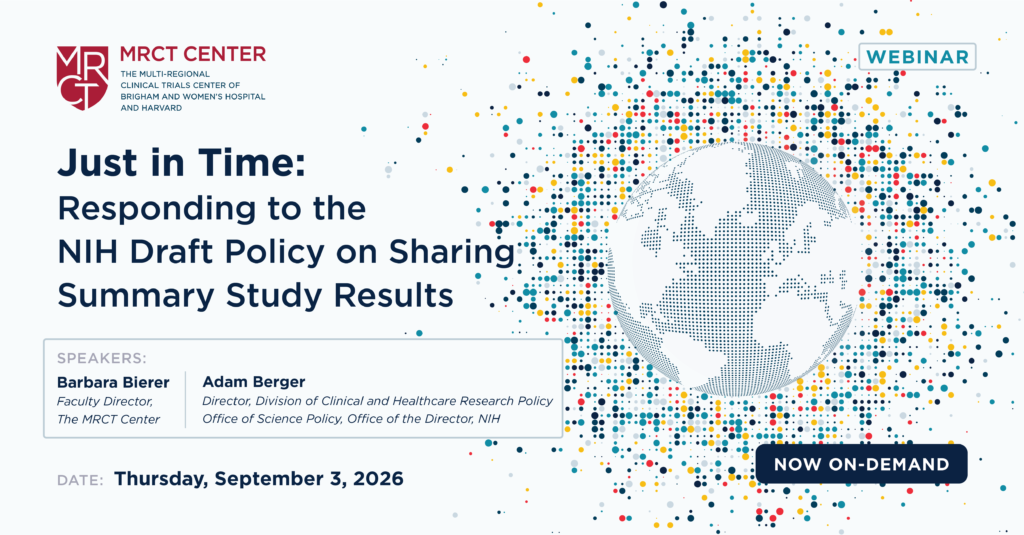
On August 27, 2026, NIH released a draft policy that would require NIH-supported researchers to share summary level study results with clinical research participants in plain language. One week later, the MRCT Center convened this webinar to walk through what the draft policy says, what it would require, and how to comment before the October 26, 2026 deadline.
The draft policy applies to all NIH-supported clinical research, not only clinical trials, regardless of funding level or mechanism. Sharing is the default expectation: where it is justifiably inappropriate, an exception must be requested and approved.
In this session:
Barbara E. Bierer, MD, Faculty Director of the MRCT Center and Professor of Medicine at Harvard Medical School, sets the context: what “summary level study results” means, why returning them is grounded in justice, beneficence, and respect for persons, and how the draft policy fits alongside international standards and regulations, including ICH E6(R3), CIOMS, the Declaration of Helsinki, and EU Regulation 536/2014. She then maps the participant journey from planning and IRB review through preparing and delivering a plain language summary, and raises the open questions the policy leaves to implementation: platform and pragmatic trials, cluster randomized designs, studies that terminate early, registries and repositories, multi-site coordination, and FDA-regulated research.
Adam C. Berger, PhD, Director of the Division of Clinical and Healthcare Research Policy in the NIH Office of Science Policy, presents NIH’s thinking behind the draft. He covers the goal of building trust and transparency in clinical research, the evidence on participant expectations, and the specific requirements under consideration: timelines for clinical trials, extramural research, and intramural research; planning and communication expectations; participant choice; and compliance and reporting.
The session closes with discussion and audience questions.
NIH is seeking comment on the purpose, definitions, scope, requirements, and compliance sections of the draft policy, and on proposed supplemental guidance covering participant preferences and experiences, best practices for researchers, and implementation needs. Each section allows up to 8,000 characters.
The Joint Task Force for Clinical Trial Competency (JTF), anchored at the MRCT Center, develops and disseminates standards and practices for the global clinical research workforce. By fostering a cohesive and collaborative approach, the JTF ensures that professionals have the competencies to conduct clinical trials ethically and effectively.
Our international team of investigators, educators, and clinical research professionals has developed and/or utilizes a framework that defines the knowledge, skills, and attitudes necessary for conducting safe, ethical, and high-quality clinical research.
This recording is from the JTF Biannual Global Meeting held June 22, 2026. The meeting focused on two recent proposed revisions to the JTF Framework: the JTF-Patient Partner Project (P3) and an update to Domain 6. Speakers presented the proposed updates, discussed them with users of the JTF Framework, and gathered input on further changes needed as the Framework moves toward Version 4.0.
How do leading organizations turn plain language from an aspiration into everyday practice? In this June 2026 MRCT Center webinar, three users of the Clinical Research Glossary share how they put it to work, from global pharma to grassroots patient advocacy.
The Clinical Research Glossary is a free, publicly available resource that translates complex clinical research terms into clear, plain-language definitions. It empowers patients, participants, and the public to make informed decisions about their care and research participation. Developed by the MRCT Center with a diverse, multi-interest-holder workgroup, its definitions have been part of the CDISC global data standards since 2023.
This session highlights real-world adoption and impact, followed by a panel discussion and audience Q&A.
Speakers
Anna Subrizi, Senior Director, Patient Empowerment, Bristol Myers Squibb. How the Glossary is embedded in BMS’s Universal Patient Language (UPL) program and used across teams for plain language summaries, informed consent forms, and patient materials.
Sudipta Chakraborty, PhD, Head, Health Literacy & Plain Language Center of Excellence, Biogen. How the Glossary became the exclusive reference for Biogen’s Plain Language Glossary 2.0 and anchors a cross-functional content reuse initiative.
R. Bernard Coley, Co-Chair, Special Interest Group – Black Diaspora; Care Partner and Research Advocate; recipient of the 2026 World Parkinson Coalition Robin A. Elliott Community Service Award. How the Glossary supports community education, including the Black Parkinson’s Disease Summit.
Moderator: Sylvia Baedorf Kassis, Program Director, MRCT Center
What’s covered
The MRCT Center and its ongoing commitment to health literacy
The Clinical Research Glossary and the collaboration with CDISC
The 2026 public review (June 12 to July 13): 27 definitions up for review, 24 new and 3 updated
Enterprise use cases from Bristol Myers Squibb and Biogen
Community and advocacy use cases in Parkinson’s disease education
Public Review is a Critical Part of the Clinical Research Glossary process.
Part of being a CDISC global plain language standard means all new terms and definitions, plus change requests we received throughout the year, go through a public review process.
Public Review of the Clinical Research Glossary happens every June. Public Review is now open: June 12 – July 13, 2026
After definitions are developed by the Clinical Research Glossary team, Public Review ensures the definitions get an extra review by people who were not involved in the project. This helps us be more confident that the definitions are clear and easy to understand.
Help us spread the word about Public Review! Click here for the Media Kit.
Send us your feedback using the MRCT Center Public Review process.
The MRCT Center’s process uses a simple survey to collect feedback.
This process will not require reviewers to create an account, but we do ask for name, organization and email address. Collecting this information allows us to validate the entry and follow-up with each person to let them know how the comment was addressed.
You can send us feedback on already posted definitions all year round and suggest new words for us to consider whenever you want. Click here to contact us.
The CDISC Public Review process is also an option if you know how to use JIRA
This works great if you already have a CDISC login and are familiar with the process. Individuals will need to create accounts to provide comments via JIRA.
CDISC has kindly provided video instructions here.
On May 22, in recognition of Clinical Trials Week, MRCT Center Executive Director Sarah White convened the ICH E6(R3) Expert Working Group’s regulator and industry topic leads, Cheryl Grandinetti, U.S. FDA; David Nickerson, EMD Serono and PhRMA ; and Rebecca Stanbrook, RESaltas GmbH and EFPIA , for “Good Clinical Practice in Practice: Implementing ICH E6(R3).” The panel walked through the guideline’s foundational concepts (Quality by Design, Quality Management, Critical to Quality Factors, and risk proportionality), grounded those concepts in a working case example using Risk-Based Quality Management principles, and discussed the practical challenges teams are encountering as they translate ICH E6(R3) into protocols, processes, and day-to-day oversight. The recording and slides are available here.
The webinar is part of the MRCT Center’s broader work as the training partner for the revised ICH E6(R3) Good Clinical Practice guideline. In collaboration with the ICH E6(R3) Expert Working Group, the MRCT Center has been developing a five-module course to help sponsors, investigators, and trial teams put the modernized guideline into practice. Module 1 (Introduction and Foundational Concepts) launched in October 2025, and Module 4 (Informed Consent) followed in January 2026. Module 3 (Data Governance) and Module 5 (Essential Records) are scheduled for release this summer, with Module 2 (Responsibilities and Oversight) to follow. The full course is available through the MRCT Center training library and the ICH Training Library.
This webinar, the fourth in the MRCT Center’s AI Digital Twins and Synthetic Data series, focused on data provenance and quality, model validation, and the emerging infrastructure needed to support the clinical and regulatory adoption of these technologies. Panelists explored how to evaluate whether the models used are credible, whether the data underlying them are reliable and traceable, and whether the outputs can be verified and validated for use in regulatory and clinical decision-making. They also discussed what it means for a model to be “fit for purpose,” how definitional differences among these technologies shape regulatory review, and how clinicians, sponsors, reviewers, and regulators may use, interpret, and deploy these tools.
Panelists: Daniele Bertolini, Principal Machine Learning Scientist, Unlearn.AI | Tina Morrison, VP, Scientific Strategy, EQTY Lab | Chao-Yi Wu, Assistant Professor of Neurology, Massachusetts General Hospital
Moderator: Barbara Bierer, Faculty Director, MRCT Center
The MRCT Center, CANTRAIN, and EUPATI hosted a webinar to unveil the results of the JTF-Patient Partner Project. This collaborative effort integrated patient and caregiver expertise directly into the JTF Framework, bringing together patient partners, academic researchers, study staff, industry representatives, and others to reimagine what patient partnership within clinical research teams should entail.
The proposed update includes a supplement focused on operationalizing patient partnership in clinical research. The results are both actionable and aspirational – a blueprint for building more skilled, inclusive, and equitable research teams that generate more responsive and impactful outcomes.
What does it take to deploy digital twins and synthetic data in clinical evidence generation — and what do regulators expect when you do?
In this third webinar in the MRCT Center’s Digital Twins and Synthetic Data series, a multidisciplinary panel examines the real-world application of these technologies across the clinical trial lifecycle. The discussion covers evidence quality and validation, regulatory benchmarks, model transparency, and the evolving landscape of FDA and EMA expectations. Panelists draw on experience spanning machine learning, FDA policy development, and drug development leadership to offer practical, grounded perspectives on what adoption looks like today — and where the field is headed.
Topics include:
Defining digital twins and synthetic data: key distinctions and appropriate uses
Reducing control arms and enhancing statistical power in randomized and single-arm trials
Applications across rare disease, oncology, and common conditions
Machine learning vs. traditional statistical approaches: complementary, not competing
Regulatory acceptance: FDA draft guidance, EMA qualification of PROCOVA, and engagement strategies
Model evaluation benchmarks and performance validation across development phases
Cultural and organizational barriers to adoption — and how to address them
Panelists: Daniele Bertolini, Principal Machine Learning Scientist, Unlearn.AI | Tala Fakhouri, VP Consulting AI & Digital Policy and Real World Evidence, Parexel | Karen Smith, Board Director, Context Therapeutics, Skye Bioscience, and Sangamo Therapeutics
Moderator: Barbara Bierer, Faculty Director, MRCT Center