ICH E6(R3) moves Good Clinical Practice toward quality by design and risk-proportionate oversight. This webinar looks at what that shift means for the people who review, run, and document clinical trials: IRBs, investigators, and study teams. The panel discusses what is changing, how the guideline relates to the US regulations that govern IRB review, the move from investigator supervision to investigator oversight, and how to decide which essential records a trial needs. The panel then applies these ideas to a case study: an investigator-initiated trial of an approved drug in a new indication for a rare neuromuscular condition, run at three sites under a single reviewing IRB.
Panelists
David Nickerson, VP, Head of Clinical Quality Management, EMD Serono, and PhRMA Topic Lead for ICH E6(R3)
Rebecca Stanbrook, Founder and Director, RESaltas GmbH, and EFPIA Topic Lead for ICH E6(R3)
Benjamin C. Silverman, MD, Senior IRB Chair, Mass General Brigham
The MRCT Center developed this course with the ICH E6(R3) Expert Working Group. Now available: Module 1 (Introduction and Foundational Concepts), Module 4 (Informed Consent), and Module 5 (Essential Records, new in September 2026). Module 3 (Data Governance) will be released in October, and Module 2 (Responsibilities and Oversight) will follow.
The earlier MRCT Center webinar covers the guideline’s foundational concepts: quality by design, quality management, critical to quality factors, and risk proportionality. Panelists were the ICH E6(R3) topic leads Cheryl Grandinetti (FDA), David Nickerson (PhRMA), and Rebecca Stanbrook (EFPIA).
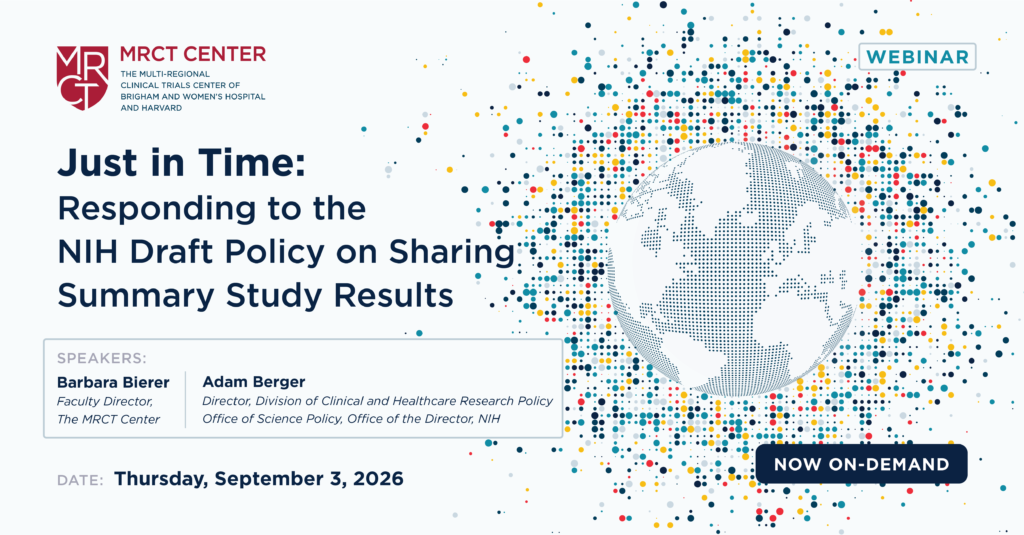
On August 27, 2026, NIH released a draft policy that would require NIH-supported researchers to share summary level study results with clinical research participants in plain language. One week later, the MRCT Center convened this webinar to walk through what the draft policy says, what it would require, and how to comment before the October 26, 2026 deadline.
The draft policy applies to all NIH-supported clinical research, not only clinical trials, regardless of funding level or mechanism. Sharing is the default expectation: where it is justifiably inappropriate, an exception must be requested and approved.
In this session:
Barbara E. Bierer, MD, Faculty Director of the MRCT Center and Professor of Medicine at Harvard Medical School, sets the context: what “summary level study results” means, why returning them is grounded in justice, beneficence, and respect for persons, and how the draft policy fits alongside international standards and regulations, including ICH E6(R3), CIOMS, the Declaration of Helsinki, and EU Regulation 536/2014. She then maps the participant journey from planning and IRB review through preparing and delivering a plain language summary, and raises the open questions the policy leaves to implementation: platform and pragmatic trials, cluster randomized designs, studies that terminate early, registries and repositories, multi-site coordination, and FDA-regulated research.
Adam C. Berger, PhD, Director of the Division of Clinical and Healthcare Research Policy in the NIH Office of Science Policy, presents NIH’s thinking behind the draft. He covers the goal of building trust and transparency in clinical research, the evidence on participant expectations, and the specific requirements under consideration: timelines for clinical trials, extramural research, and intramural research; planning and communication expectations; participant choice; and compliance and reporting.
The session closes with discussion and audience questions.
NIH is seeking comment on the purpose, definitions, scope, requirements, and compliance sections of the draft policy, and on proposed supplemental guidance covering participant preferences and experiences, best practices for researchers, and implementation needs. Each section allows up to 8,000 characters.
On May 22, in recognition of Clinical Trials Week, MRCT Center Executive Director Sarah White convened the ICH E6(R3) Expert Working Group’s regulator and industry topic leads, Cheryl Grandinetti, U.S. FDA; David Nickerson, EMD Serono and PhRMA ; and Rebecca Stanbrook, RESaltas GmbH and EFPIA , for “Good Clinical Practice in Practice: Implementing ICH E6(R3).” The panel walked through the guideline’s foundational concepts (Quality by Design, Quality Management, Critical to Quality Factors, and risk proportionality), grounded those concepts in a working case example using Risk-Based Quality Management principles, and discussed the practical challenges teams are encountering as they translate ICH E6(R3) into protocols, processes, and day-to-day oversight. The recording and slides are available here.
The webinar is part of the MRCT Center’s broader work as the training partner for the revised ICH E6(R3) Good Clinical Practice guideline. In collaboration with the ICH E6(R3) Expert Working Group, the MRCT Center has been developing a five-module course to help sponsors, investigators, and trial teams put the modernized guideline into practice. Module 1 (Introduction and Foundational Concepts) launched in October 2025, and Module 4 (Informed Consent) followed in January 2026. Module 3 (Data Governance) and Module 5 (Essential Records) are scheduled for release this summer, with Module 2 (Responsibilities and Oversight) to follow. The full course is available through the MRCT Center training library and the ICH Training Library.
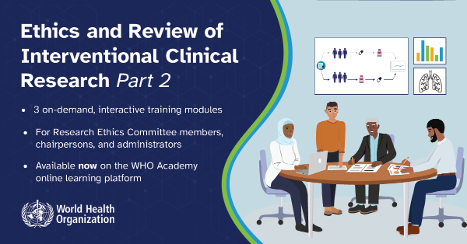
Across 3 video-based modules, paired with interactive case studies and activities, learners will gain practical, in-depth guidance on providing ethical oversight of health-related research involving human participants. By the end of the course, learners will be able to explain how a Research Ethics Committee (REC) provides oversight from initial review through study closure; articulate why robust Standard Operating Procedures (SOPs) are essential to REC operations; describe the roles and responsibilities of other stakeholders involved in clinical research oversight; and identify methods to assess and strengthen REC operations.
Developed by: Joint Task Force for Clinical Trial Competency (JTF), Maroof International Hospital, National University of Medical Sciences (NUMS), Munaza Jamil of McMaster University
The Joint Task Force for Clinical Trial Competency (JTF), anchored at the MRCT Center, develops and disseminates standards and practices for the global clinical research workforce. By fostering a cohesive and collaborative approach, the JTF ensures that professionals have the competencies to conduct clinical trials ethically and effectively.
Our international team of investigators, educators, and clinical research professionals has developed and/or utilizes a framework that defines the knowledge, skills, and attitudes necessary for conducting safe, ethical, and high-quality clinical research.
The meeting featured five presentations demonstrating real-world implementation of the JTF Framework:
From Translation to Transformation: Advancing Clinical Research Competencies in Pakistan through the Urdu JTF Framework
Designing Experiential Learning with a Focus on JTF Competencies at North Carolina Central University
Applying JTF Competencies in a Master’s-Level Clinical Data Science Program
Professional Development of the Clinical Research Workforce in New Zealand Public Hospitals
Advancing Professional Standards and Recognition for Australian Clinical Trials Professionals
On-demand Recording on YouTube (with timestamps)
Note: The recording includes timestamps for each of the five presentations.
Good Clinical Practice (GCP) is an international, ethical, scientific, and quality standard for the conduct of trials that involve human participants. The MRCT Center developed and designed this course in collaboration with the ICH E6(R3) Expert Working Group (EWG). This course consists of 5 modules introducing and explaining the key concepts of the E6(R3) guideline. This training is intended for anyone involved in the conduct of an interventional clinical trial. The course links will take the learner to the ICH Training Library website. Courses are free for all registrants.
Currently available is:
Module 1: Introduction and Foundational Concepts, published in October 2025
Integrating JTF Competencies: Curriculum Design and Accreditation at Arizona State University
Comprehensive leveling of the Clinical Research Professional Career Ladder at Johns Hopkins University
Results from a Delphi study on data management competencies
Expanding the Core Competency Framework to include patient, participant, and public engagement and partnership: Updates from the Patient Participant Project workgroup
Research Ethics Committee & Regulatory Systems Optimization
TRACE (Trial Regulatory and Clinical Ethics Optimization) is a dynamic initiative to strengthen and streamline clinical trial regulatory and ethics systems across Africa. Its mission is to remove barriers to clinical research by streamlining review processes, reducing duplication, and establishing clear, efficient timelines.
Despite growing interest in African clinical research, sponsors still encounter unclear submission pathways, manual or outdated systems, redundant reviews, and unpredictable timelines, all barriers TRACE aims to eliminate.
The MRCT Center, as a member of TRACE’s Core Project Team and lead of the Capacity Building & Accreditation and Funding Models sub-teams, is working alongside the African Vaccine Regulatory Forum (AVAREF) and Garnet Partners, with funding support from the Gates Foundation, to design and implement sustainable regulatory and ethics solutions.
In close collaboration with local stakeholders, TRACE co-develops tools, templates, and resources tailored to the needs of African ethics committees. It promotes inter-institutional coordination and cooperation.
By bringing together national ethics committees (NECs), institutional review boards (IRBs), regulatory agencies, and sponsors, TRACE fosters a transparent, efficient, and sustainable environment for clinical research oversight. The initiative’s goal is to position Africa as a leading hub for clinical research, with pilot efforts currently underway in Rwanda, Tanzania, Zimbabwe, Nigeria, and, more recently, Kenya.
As part of its role, the MRCT Center leads national system assessments using the WHO Global Benchmarking Tool for Ethics Committees, provides targeted training and capacity-building programs for NECs, and supports the implementation of IRB reliance strategies. It is also collaborating with stakeholders to design a model fee structure and contributing to long-term financial sustainability and regulatory alignment.
To further support training, the MRCT Center offers an online, on-demand training course on Ethics and Review of Interventional Clinical Research available free on the WHO Academy platform. A follow-up course, Ethics and Review of Interventional Clinical Research II, is currently in development and expected in fall 2025.
Ultimately, TRACE is committed to establishing a sustainable, efficient, and globally dependable landscape for clinical research across Africa by tackling persistent challenges such as manual workflows, redundant reviews, and inconsistent timelines.
OBJECTIVES
Ethics Systems Strengthening: Enhancing NEC and IRB capabilities, developing accreditation frameworks, and operationalizing a national accreditation program.
Capacity Building: Providing comprehensive training, curriculum development, and resource support to empower ethics committees and regulatory authorities.
Financial Sustainability: Creating equitable fee structures, implementing differentiated charging models, and constructing robust financial sustainability strategies for NECs.
Integration with National Authorities: Facilitating the alignment of ethics systems with national regulatory infrastructures.
Regulatory Optimization: Simplifying submission pathways and review procedures to reduce ambiguity and inefficiency.
KeY MILESTONES
December 2025: Visit to Kenya to convene key stakeholders, including NACOSTI, PPB, and ISERCs from Moi Hospital and KEMRI, to support their participation in TRACE
August 2025: Financial Sustainability sub-team kickoff meeting
July–August 2025: Core team face-to-face meeting in Kigali to discuss project direction with participating countries
July 2025: Capacity Building sub-team kick-off meeting
June 2025: Visit Zimbabwe and Tanzania for gap and opportunity assessment
April–May 2025: Visit Nigeria and Rwanda to consult with NECs and regulatory bodies on gaps and opportunities
February 2025: Kick-off meeting with core team for the Africa Clinical Trial Regulatory and Ethics System Optimization project
October 2024: Released online course “Ethics and Review of Interventional Clinical Research”
February 2024: Meetings in Rwanda and Zimbabwe to strengthen and sustain the clinical trial ecosystem in Africa
January 2024: Meetings in Ethiopia for assessment of clinical trial system
May 2023: Presented MRCT Center’s capacity building effort at AVAREF meeting in Cameroon
December 2022: Clinical Trial Optimization visit in Kenya and Nigeria
March/April 2022:Training for Ethics Review of Clinical Research: A Virtual Training Course for Africa- Part 2
September 2021: Training for Ethics Review of Clinical Research: A Virtual Training Course for Africa – Part 1
project Leadership & sTAFF
Barbara E. Bierer, MD, Faculty Director, MRCT Center
Sarah White, MPH, Executive Director, MRCT Center
Willyanne DeCormier Plosky, DrPH, Program Director, MRCT Center
Hayat Ahmed, MSc, Program Manager, MRCT Center
Lauren Otterman, MBHL, Project Manager, MRCT Center
The Convergence Project is pleased to invite you to an upcoming virtual event hosted by the MRCT Center, focused on workforce development strategies to support a more dynamic and competitive clinical research workforce.
This meeting will bring together community leaders, policymakers, and researchers to discuss how to create and support pathways into the clinical trial workforce (e.g., part-time degree programs, community colleges, fellowships). Key topics will include workforce development, targeted recruitment, and actionable steps to drive systemic improvements. You’ll have the opportunity to engage with panelists leading programs in Georgia, North Carolina, West Virginia, and other states across the country.
We hope you can join us for this important conversation. We look forward to your participation!